We build wood cutting boards in our family shop in Warren, Michigan. So you can guess which side we're on.
But you deserve more than a sales pitch. Here is what the research says about knives, germs, microplastics, and care. That includes the parts that don't land neatly in our favor.
The short answer
A well-made hardwood board is easy on your knives. It holds up to years of daily use with simple care. And it doesn't shed plastic into your food.
Plastic boards are cheap and go in the dishwasher. But they scar fast and need replacing.
Metal and glass boards look clean and wipe off easily. But they are hard on knife edges.
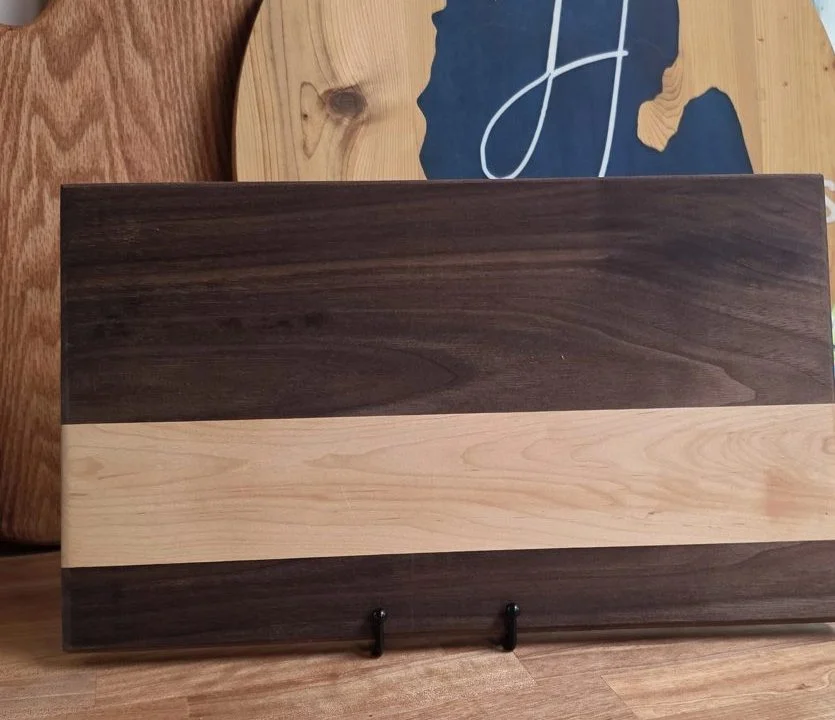
Which cutting board is best for your knives?
A knife edge is thin. When it hits a surface harder than itself, it rolls or chips.
Metal and glass are that surface. In 2026, America's Test Kitchen tested five metal boards, both titanium and stainless steel. Every one dulled a brand-new chef's knife "dramatically." One board dulled its knife within four uses. A wood board kept the same kind of knife in near-new condition. They also tell cooks to skip glass boards, which are too hard for knives and can shatter if dropped.
Plastic is soft, so it's gentle on knives too. Where plastic falls short is what happens to the board itself, which we'll get to next.
We like end grain boards for heavy knife work. On an end grain board like our End Grain Mahogany Cutting Board, the blade meets the ends of the wood fibers instead of slicing across them. For everyday chopping, a thick edge grain board like our Walnut, Maple & Cherry Cutting Board is a workhorse.
Are wood cutting boards sanitary?
Yes, when you take care of them. A lot of people assume plastic is cleaner. The research is more mixed than that.
In a 1994 study in the Journal of Food Protection, researchers Nese Ak, Dean Cliver, and Charles Kaspar tested more than 10 hardwoods and several plastics with bacteria like E. coli, Salmonella, and Listeria. New plastic boards were easy to clean. But once plastic was scarred by knife cuts, the researchers found it nearly impossible to clean and disinfect by hand. Used wood boards with lots of knife marks behaved almost the same as new wood. More bacteria came back from used plastic than from used wood.
Ben Chapman, a food safety expert at NC State University, explains it this way. Hard, fine-grained woods like maple trap bacteria, and the bacteria die off as the board dries. Soft woods like cypress are a bigger risk. That's one reason we build with hardwoods like maple, walnut, cherry, and mahogany.
To be fair, not every lab has gotten the same results. And no board cleans itself, wood or plastic. What keeps any board safe is how you use it:
Wash it with hot, soapy water after every use.
Dry it fully. Stand a wood board on its edge so air reaches both sides.
Use a separate board for raw meat, poultry, and seafood. NC State suggests plastic for raw meat and wood for fruit, vegetables, bread, and ready-to-eat food. That's a smart system for any kitchen.
Do plastic cutting boards shed microplastics?
Yes. A 2023 study in Environmental Science & Technology looked at what comes off boards when you chop. The researchers estimated a person could produce 14 to 71 million polyethylene microplastic particles a year from a polyethylene board, and about 79 million from a polypropylene board.
Here is the honest part. Wood boards shed particles too. In that same study, wood actually gave off more particles than plastic. The difference is that those particles are wood, not plastic. In lab tests on mouse cells, neither the polyethylene particles nor the wood particles hurt the cells. The authors called it a small study, and scientists don't yet know what microplastics from boards mean for human health.
If you're trying to cut down on plastic in your kitchen, a wood board is an easy place to start.
How long does a wood cutting board last?
Plastic boards wear out. Food safety experts at NC State and the University of Illinois say to replace a board once it has deep grooves.
A good hardwood board can last for years, even generations, with a little care:
Hand wash it. Never soak it or run it through the dishwasher.
Keep it away from long stretches of sun or heat.
Oil it when it looks dry or lighter in color. Use food-safe mineral oil or cutting board oil, not olive or vegetable oil, which can go rancid.
When knife marks build up, a wood board can be sanded smooth and refinished. You can't do that with plastic.
Every Howard Family Designs cutting board and charcuterie board gets a mineral oil bath and beeswax-based board conditioner before it ships, so it arrives ready to use. Our Board Maintenance guide walks you through the rest, step by step.
A board you're proud to leave out
This part isn't science, but it matters. A plastic board lives in a cabinet. A wood board can live on the counter.
Walnut, maple, cherry, and mahogany each bring their own color and grain. Our Sunset Cutting Board and Sunrise Cutting Board pair mahogany and hard maple in a striped pattern. Our Walnut & Maple Cutting Board is reversible and can be engraved, which makes it a great gift. And when it's time to serve, our American Cherry Charcuterie Board and Michigan Hard Maple Charcuterie Board carry the food to the table.
Wood vs. plastic vs. metal at a glance
Wood: gentle on knives, lasts for years with care, can be sanded and refinished. Hand wash only and oil it now and then.
Plastic: low cost and dishwasher safe. Scars quickly, sheds microplastics, and needs replacing once grooved.
Metal and glass: easy to wipe clean. Hard on knife edges, and glass can break.
Frequently asked questions
Is wood or plastic better for raw meat?
Either can work if you clean it well and keep it separate from produce. Many food safety experts suggest a dedicated plastic board for raw meat and a wood board for everything else.
Can a wood cutting board go in the dishwasher?
No. The heat and water can warp and crack it. Hand wash it with mild soap and warm water, then dry it on its edge.
How often should I oil my wood cutting board?
Whenever it looks dry or lighter in color. Make sure the board is completely dry first, then let the oil soak in for at least an hour before you wipe off the extra.
What is the best wood for a cutting board?
Hard, fine-grained hardwoods like maple are a classic choice. Walnut, cherry, and mahogany are also hardwoods with beautiful grain.
Is a metal cutting board worth it?
For your knives, no. Metal boards dulled knives fast in America's Test Kitchen's 2026 testing.
Handmade in Warren, Michigan
Howard Family Designs is a family woodworking shop in Warren, serving Metro Detroit and shipping beyond. We build artisan furniture while building lives in the process. Every order helps us train younger woodworkers, and we plant a tree with every order.
Ready for a board that lasts? Shop our cutting boards, or book a free consultation if you want something custom.
Sources
Ak, N. O., Cliver, D. O., and Kaspar, C. W. (1994). "Cutting boards of plastic and wood contaminated experimentally with bacteria." Journal of Food Protection 57: 16–22.
Yadav, H., et al. (2023). "Cutting Boards: An Overlooked Source of Microplastics in Human Food?" Environmental Science & Technology. DOI: 10.1021/acs.est.3c00924.
NC State University News (2014). "Fast Facts About Cutting Boards and Food Safety in Your Kitchen," with Ben Chapman.
University of Illinois Extension. "Cutting Boards," Meat Safety.
America's Test Kitchen (2026). "Why We Don't Recommend Metal Cutting Boards."
America's Test Kitchen. "Why You Should Never Use a Glass Cutting Board."